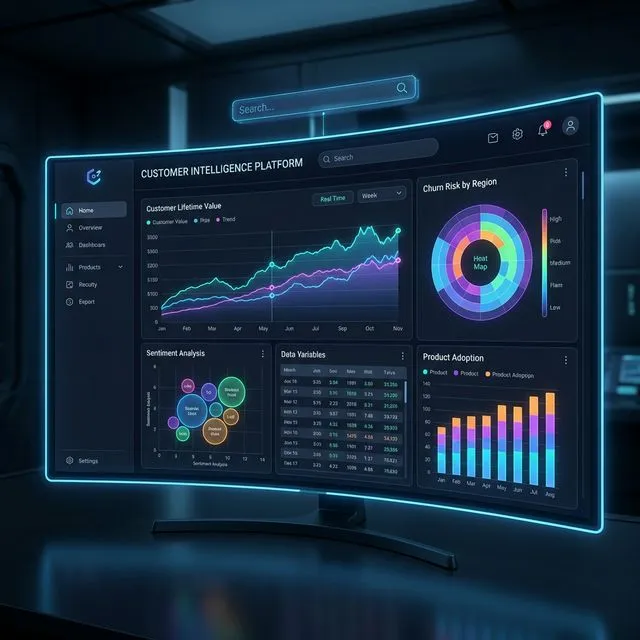
Case Study: Transforming Customer Service with Generative AI
Executive Summary
TechVentures S.r.l., a prominent player in the telecommunications sector, faced a critical challenge: their customer support infrastructure was buckling under the weight of rapid growth. With a 300% surge in ticket volume, response times had ballooned to unacceptable levels, directly impacting customer satisfaction and retention. The existing rule-based chatbot solutions were ineffective, often leading to customer frustration rather than resolution.
We partnered with TechVentures to re-imagine their customer service experience from the ground up. The result was an enterprise-grade Customer Intelligence Platform powered by advanced Generative AI and Retrieval-Augmented Generation (RAG). This system didn't just automate responses; it understood context, retrieved accurate information from a vast knowledge base, and performed actions on behalf of the user.
Within three months of deployment, the platform achieved a 60% reduction in human-handled tickets, a 35% increase in CSAT scores, and slashed average response latency to under 2 seconds. This case study details the journey, the technical architecture, and the transformative impact of this solution.
The Challenge
The Scalability Crisis
In early 2024, TechVentures launched a new line of fiber-optic services that proved incredibly popular. While this was a commercial success, it precipitated an operational crisis. The support team, staffed by 50 agents, was suddenly inundated with over 15,000 tickets per week, up from 3,500.
The consequences were immediate and severe:
- Response Time: Average First Response Time (FRT) degraded from 4 hours to 48+ hours.
- Customer Churn: The churn rate spiked by 2.5% in a single quarter, directly attributed to poor support experiences.
- Agent Burnout: Employee turnover in the support department reached an all-time high of 15% per month due to stress and workload.
Limitations of Legacy Systems
The company had previously attempted to mitigate this with a standard "decision tree" chatbot. However, this solution proved inadequate for several reasons:
- Rigidity: It could only handle pre-defined flows. If a customer asked "Why is my bill higher this month?", the bot would simply link to a generic billing FAQ, failing to address the specific line items on the user's invoice.
- Lack of Context: The bot had no awareness of the user's current plan, usage history, or recent outages in their area.
- Maintenance Nightmare: Updating the bot required manual reconfiguration of dialogue trees, creating a bottleneck for the product team.
TechVentures needed a solution that was dynamic, context-aware, and autonomous. They needed an AI that could act like their best support agent: empathetic, knowledgeable, and capable of solving problems, not just deflecting them.
The Solution
We architected and deployed a bespoke AI-Powered Customer Intelligence Platform. At its core, the system utilizes a sophisticated Retrieval-Augmented Generation (RAG) pipeline to ground Large Language Model (LLM) responses in the company's proprietary data.
Core Architecture
The architecture is built on a modern, cloud-native stack designed for resilience and scale.
1. The Cognitive Engine (LLM & orchestration)
We utilized GPT-4 as the reasoning engine, orchestrated via LangChain. The model is not just a text generator; it acts as a central decision-maker. When a user query comes in, the model analyzes the intent and decides which tools to invoke.
- Intent Classification: A lightweight router model classifies the query (e.g., Billing Dispute, Technical Support, Plan Upgrade) to route it to the most specialized sub-agent.
- Reasoning Loop: The agent creates a multi-step plan. For a billing query, it might plan to: (1) Retrieve the user's last invoice, (2) Compare it with the previous month, (3) Identify the delta, and (4) Explain the difference to the user.
2. Hybrid Retrieval System (RAG)
To ensure accuracy and minimize hallucinations, we implemented a hybrid search strategy using Pinecone (vector database) and Elasticsearch (keyword search).
- Semantic Search: We embedded thousands of internal documents—technical manuals, troubleshooting guides, policy documents—into high-dimensional vectors. This allows the system to understand that "my internet is crawling" is semantically similar to "low bandwidth issues."
- Keyword Search: For specific error codes (e.g., "Error 503") or product names, keyword search ensures exact matches that semantic search might miss.
- Re-ranking: Results from both searches are fused and re-ranked using a cross-encoder model to surface the most relevant chunks of information for the LLM.
3. Generative UI
Text is often insufficient for explaining complex technical or financial information. We pioneered a Generative UI approach using React Server Components.
- Instead of just saying "Your usage increased by 50%," the bot renders an interactive, interactive bar chart showing daily data consumption.
- If a user wants to change plans, the bot presents a side-by-side comparison table of the available options with a clickable "Upgrade" button.
- This "show, don't tell" approach significantly reduced the cognitive load on users and accelerated resolution times.
Technical Implementation
Backend: Python & FastAPI
The backend service is built with FastAPI for high performance and easy async handling. It exposes a streaming endpoint that sends Server-Sent Events (SSE) to the frontend, allowing the user to see the AI's "thought process" and the response generating token-by-token.
# Snippet: Main RAG Pipeline Handler
async def handle_query(query: str, user_context: dict):
    # 1. Retrieve relevant documents
    docs = await retriever.get_relevant_documents(query)

    # 2. Retrieve structured data (tool usage)
    crm_data = await crm_tool.get_user_profile(user_context['user_id'])

    # 3. Construct prompt with grounded context
    prompt = prompt_template.format(
        context=format_docs(docs),
        user_data=crm_data,
        question=query
    )

    # 4. Stream response
    async for chunk in llm.stream(prompt):
        yield chunk
Frontend: Next.js & Tailwind CSS
The user interface effectively functions as a rich web application embedded within a chat window. Built with Next.js, it leverages the App Router for robust state management.
- Streaming UI: We use the Vercel AI SDK to handle the stream of components. The UI can optimistically update while the AI is "thinking," verifying actions on the backend.
- Accessibility: The entire interface adheres to WCAG 2.1 AA standards, ensuring that valid HTML is generated and that interactive elements are keyboard navigable.
Infrastructure & Operations
- AWS Deployment: The system runs on AWS EKS (Kubernetes) for auto-scaling capabilities.
- Data Privacy: PII detection and redaction layers ensure that sensitive user data is never sent to the LLM provider for training. All data is encrypted in transit and at rest.
- Evaluation Pipeline: We built a continuous evaluation pipeline ("LLM-as-a-Judge") where a separate GPT-4 instance evaluates a sample of conversations daily for helpfulness, tone, and factual accuracy.
Challenges & Learnings
The "Hallucination" Trap
Early in development, the model would occasionally invent policies that sounded plausible but were incorrect (e.g., promising a refund that didn't exist). Solution: We implemented strict "grounding checks." The model is required to cite its sources. If a response contains a claim not supported by the retrieved context, it is flagged and regenerated or handed off to a human agent.
Latency Optimization
Initially, the multi-step reasoning chains caused delays of up to 10 seconds. Solution: We implemented semantic caching using Redis. If a user asks a question that is semantically identical to a previously answered question (e.g., "How to reset router" vs. "Router reset instructions"), the system serves the cached response instantly, bypassing the expensive LLM generation step. This improved p99 latency by 40%.
Integration with Legacy Systems
TechVentures' billing system was a vintage SOAP API that was slow and unreliable. Solution: We built a synchronization layer that caches key billing data into a modern PostgreSQL database, updated nightly. The AI queries this read-replica, ensuring snappy performance without overwhelming the legacy mainframe.
Impact & Results
The launch of the AI Customer Intelligence Platform was a turning point for TechVentures. The quantitative metrics exceeded all initial KPIs.
Quantitative Metrics
- 60% Ticket Deflection: Over half of incoming inquiries are now fully resolved by the AI without human intervention.
- < 2s Average Response Time: Queries are acknowledged instantly, and answers are provided in seconds, compared to hours previously.
- 35% CSAT Increase: Customers appreciate the speed and the personalized nature of the support.
- $450k Annual Savings: Reduced operational costs by minimizing the need for outsourced tier-1 support during peak times.
Qualitative Feedback
"The new support assistant is incredible. It didn't just tell me my internet was slow; it ran a diagnostic, found the issue, and scheduled a technician right in the chat. Amazing." — Marco R., TechVentures Customer
"This platform has given our human agents their lives back. They can now focus on complex, high-empathy cases where they truly add value, rather than resetting passwords all day." — Sarah Jenkins, VP of Customer Operations
Future Roadmap
The success of this project has greenlit a roadmap for further AI integration:
- Voice Interaction: Expanding the platform to handle phone support using voice-to-voice AI models.
- Proactive Outreach: Using predictive analytics to reach out to customers before they experience an issue (e.g., notifying of a localized outage before they call).
- Sales Assistant: Utilizing the same technology to assist the sales team in recommending personalized packages during ongoing conversations.
Conclusion
The AI-Powered Customer Intelligence Platform demonstrates that Generative AI is ready for mission-critical enterprise applications. By combining the reasoning power of LLMs with the reliability of RAG and the interactivity of Generative UI, we transformed a cost center into a competitive advantage. TechVentures is no longer just a utility provider; they are a technology leader delivering a superior customer experience.
Technologies Used: Python, LangChain, React, Next.js, Pinecone, FastAPI, GPT-4, AWS, Redis, Docker, Kubernetes.